Tuesday, September 17, 2019

Great King Jeroboam II missing from Chronicles


by
 
Damien F. Mackey


Reading through the accounts of the kings of Israel in Kings and Chronicles,
I was really surprised to find that Jeroboam II does not figure in Chronicles.
 
 
Suspecting this morning (16th September, 2019), once again, that there may be some degree of duplication amongst the listings of the kings of Israel of the Divided Monarchy period, which thought prompted me later today to write:
 
Bible Bashing Baasha problem king of Israel. Part One: Reprising my earlier Baasha View
 
https://www.academia.edu/40361733/Bible_Bashing_Baasha_problem_king_of_Israel._Part_One_Reprising_my_earlier_Baasha_view
 
and then reading through the accounts of the kings of Israel in Kings and Chronicles, I was really surprised to find that Jeroboam II does not figure in Chronicles.
That I was not mistaken or deluding myself about this was confirmed when I read introductory parts of Todd Bolen’s thesis (2002):
 
The Reign of Jeroboam II: A Historical and Archaeological Interpretation
 
https://www.academia.edu/1644551/The_Reign_of_Jeroboam_II_A_Historical_and_Archaeological_Interpretation
 
For instance, Bolen commences by writing of the scant treatment of Jeroboam II in the entire Scriptures despite the king’s undoubted importance:
 
It has long been recognized that some of the most defining political and military events received little attention from the theologically-oriented writer of the Scriptures. Jeroboam II was one such king whose importance to Israel’s political history went virtually unnoticed in the biblical record. Though he ruled longer than any other king of the north, the Scriptures accord him one of the briefest treatments of all kings (2 Kings 14:23-29). Much of this record is not unique to Jeroboam, but simply repeats the standard formulaic denunciation of wicked rulers.
 
The most peculiar feature of the biblical record of Jeroboam’s rule is its report of his territorial expansion: “He was the one who restored the boundaries of Israel from Lebo Hamath to the Sea of the Arabah.... He recovered for Israel both Damascus and Hamath, which had belonged to Judah” (2 Kings 14:25, 28). Typical assessments of Jeroboam’s reign extrapolate this note of northern expansion to include unprecedented glory, wealth, and prosperity for the nation of Israel. Conversely, recent attempts have been made to reject all suggestions of material prosperity or territorial expansion under Jeroboam II.
 
This study assesses the rule of Jeroboam II by first considering his historical background. The devastating oppression by the Arameans in the days before Jeroboam came to the throne are the backdrop for the expressions of expansion and wealth. Assyrian campaigns against Damascus reversed the fortunes of the southern Levant at the beginning of the eighth century B.C., and allowed Israel to rebound from a time of territorial oppression and economic poverty. The geographical references are studied in order to best understand the precise extent of Jeroboam’s kingdom to the north, east, and south. The conclusion of this study is that by the latter half of Jeroboam’s reign, Hamath and Damascus were paying regular tribute to Israel, much of Transjordan was under Israelite control, and the nation of Judah was an ally.
 
The archaeological record of the first half of the eighth century reveals a period of renewed construction and some measure of material prosperity. However, the current state of archaeological research does not support the position that Jeroboam’s kingdom was wealthier than the kingdom of Ahab. Analysis of the excavations at Hazor, Tirzah, Dan, Samaria, and Megiddo indicate that Israel at this time experienced a resurgence, and specific material finds at these sites reflect a degree of prosperity that appears limited primarily to the upper class.
The Samaria ostraca attest to an administrative system in Jeroboam’s coregent years whereby governmental officials were given land grants to meet their needs while residing at the king’s table at the capital. An understanding of the society of Jeroboam’s day is completed with a study of Amos’ and Hosea’s records of the Israelites’ religious and social failures.
 
Then Bolen, in his Introduction to Chapter I, will proceed to tell of this startling fact: “Chronicles does not so much as hint of his existence, even in regnal synchronisms”:
 
For slightly over two hundred years, the northern kingdom of Israel survived as a sovereign nation in the tumultuous ancient Near East. Situated amidst larger and stronger powers, Israel was easily affected by the political forces and movements of the empires and powers around her. Within the relatively short span of two hundred years, Israel endured devastating conquest by the Egyptians, exacting tribute payments to the Assyrians, crushing oppression by the Arameans, damning idolatrous influence from the Phoenicians, but rarely satisfying independence.
 
After Jeroboam ben Nebat led the northern tribes away from a united kingdom with Judah, Israel would never again hold the territorial dominion that it enjoyed under David and Solomon, save perhaps one time. Control of the trade routes would often be contested, and Israel would frequently be on the losing end. The history of this nation was not one in which to take great pride; its existence was marked by foreign oppression, dynastic usurpations and rival reigns.
 
The characteristics of Jeroboam II’s rule were not unlike those of his nation; it was not an era of uniform prosperity, peaceful coexistence, or popular satisfaction. His age was one marked by both blessings and curses, rises and falls, successes and failures, prosperity and adversity. The unvaried character sometimes attributed to the first half of the eighth century BC is unfounded. Israelite society reflected a wide range of events, circumstances and feelings, and Jeroboam’s reign was anything but static.
 
The first half of the eighth century was not a replication, however, of any other period of Israel’s existence. No king of Israel ruled longer than Jeroboam II, and no dynasty had as many monarchs sit on the throne as did that of Jeroboam’s forebear, Jehu. Jeroboam’s rule stands in stark contrast to that of his predecessors and successors. The half-century before him witnessed the most violent and trying time of persecution Israel had ever faced. Beaten down so that they were like “dust at threshing time,” the apostate rulers of Israel ultimately sought out even the Lord for salvation (2 Kgs 13:7). The last half of the ninth century was most unlike the period of expansion and economic growth that Jeroboam fostered, and the stability that he established would be unknown after his death. In the period following Jeroboam, a duration shorter than Jeroboam’s reign, the country would have six rulers, four of them dying violent deaths. In fact, the Israelite nation under Jeroboam experienced an age that was unique - both in strength and stability.
 
Without the brief record in the Book of Kings and cursory mentions in two prophetic works, the name of this man would not be preserved (2 Kgs 14:23-15:8; Amos 1:1; 7:9-11; Hos 1:1). Even the parallel account of the history of the Divided Monarchy neglects to mention Jeroboam, even in passing.
Chronicles does not so much as hint of his existence, even in regnal synchronisms. This king of unusually long reign and reported strong position is not attested to in Assyrian, Aramean, Hamathite, Babylonian, or Egyptian annals or inscriptions. Furthermore, the known history of the ancient Near East for his period is surprisingly sparse; very little has been preserved. The extent of the historical record is related in the Book of Kings:
 
In the fifteenth year of Amaziah son of Joash king of Judah, Jeroboam son of Jehoash king of Israel became king in Samaria, and he reigned forty-one years. He did evil in the eyes of the LORD and did not turn away from any of the sins of Jeroboam son of Nebat, which he had caused Israel to commit. He was the one who restored the boundaries of Israel from Lebo Hamath to the Sea of the Arabah, in accordance with the word of the LORD, the God of Israel, spoken through his servant Jonah son of Amittai, the prophet from Gath Hepher. The LORD had seen how bitterly everyone in Israel, whether slave or free, was suffering; there was no one to help them. And since the LORD had not said he would blot out the name of Israel from under heaven, he saved them by the hand of Jeroboam son of Jehoash. As for the other events of Jeroboam’s reign, all he did, and his military achievements, including how he recovered for Israel both Damascus and Hamath, which had belonged to Judah, are they not written in the book of the annals of the kings of Israel? Jeroboam rested with his fathers, the kings of Israel. And Zechariah his son succeeded him as king. (2 Kgs 14:23-29 NIV4)
 
The sources for Jeroboam’s forty-year reign are, unfortunately, not only brief but sketchy as well. Very few details about his military accomplishments, economic prosperity, or administrative ability are known. The extrabiblical sources for this period of time are also very limited. Jeroboam’s father is recorded as having paid tribute to the Assyrians a few years prior to Jeroboam’s accession. The usurper of the throne of Jeroboam’s son also received mention for a similar action some ten years after Jeroboam’s death. The Samaria Ostraca likely date to the time of Jeroboam, but their interpretation and implications are somewhat unclear. The Zakkur and Pazarcik stelae both record contemporaneous events, but far to the north of Israelite territory. Assyrian annals concentrate on the troublesome events of home, and any western excursions receive very little detail. No inscriptions have been found from the smaller nations neighboring Israel.
 
The prophets Amos and Hosea both date at least a portion of their oracles to the reign of Jeroboam. Amos’ work is particularly valuable as he details the oppression of the lower class. His sharp remarks, pointed denunciations, and predictions of judgment undoubtedly reflect the Israelite society during this period. Also, Amos is unique in specifically condemning the Israelite monarch for his wickedness (7:9-11). Hosea appears to have begun his prophetic ministry during the reign of Jeroboam (1:1), but his words are more general in nature. ….
[End of quote]
 
Bolen’s opening remark, “that some of the most defining political and military events received little attention from the theologically-oriented writer of the Scriptures”, may not necessarily be entirely true. Jeroboam so-called II may figure more prominently in the Scriptures than is thought – but under an alter ego.
A good place to begin to look for that would be, I suggest, with namesake Jeroboam I.

Shalmaneser III and V


by
 
Damien F. Mackey


“… there is no known relief depiction of Shalmaneser V …”. 


With that particular quote, on a previous occasion, I had introduced my brief article:
 
Shalmaneser V and Nebuchednezzar II were 'camera-shy'?
 
 
While it might reasonably be expected that ancient kings to whom great deeds are attributed - as is the case with Shalmaneser V (despite his supposedly short reign) and, far more especially, with Nebuchednezzar ‘the Great’ - would have abundant statues and relief depictions dedicated to them, it was found in the above article that there is virtually nothing of this nature for these two kings combined.  
 
That irregular situation, to my way of thinking, screams out the need for alter egos.
And these I have provided in abundance for Nebuchednezzar, for example in my article:
 
Aligning Neo-Babylonia with Book of Daniel. Part Two: Merging late neo-Assyrians with Chaldeans
 
 
Various of the alter egos whom I have attached to Nebuchednezzar in this article can boast of numerous statues and relief depictions.
 
The separate issue of the neo-Assyrian king, Shalmaneser so-called V, and who else he might have been, has arisen in a recent exchange of e-mails I have had with a would-be revisionist, who has sent me his hopeful revision of Assyrian history. (Yet another one of these!)
He wrote in part:
 
Hello Dr. [sic] Mackey,
 
I've been enjoying your series on academia.com.
 
Here is the key to the Assyrian King List.  It is, like Manetho, dynasties by city, which are in parallel.  
...
Shalmaneser III is Shalmaneser V ....
 
 
Without my yet knowing very much about what this correspondent has come up with, I thought that I needed to fire off this note of caution – though not intending to dampen any enthusiasm?
 
.... It is no easy task .... I'll tell you why - you may already have realised this.
Shamaneser III has been an enormous problem for me and indeed for others.
It is one thing to say that he is Shalmaneser V, who I think he is, but quite another to show how the long reign of III can be squared off against the very short reign (conventionally speaking) of V. 
(I personally would enlarge V to embrace also Tiglath-pileser III).
You need to be able to explain the Black Obelisk of III now in your revised context. Who, for instance, is the apparent king of Israel mentioned there?
And how do the recorded names of participants in the Battle of Karkar (Qarqar), opponents of III, fit into your revised scenario?
These are only some of the issues with which you would be faced. Not sufficient simply to declare that Assyrian king X = Assyrian king Y.
 
For reasons such as the above I have held off so far with a revision of Shalmaneser so-called III. ....https://ssl.gstatic.com/ui/v1/icons/mail/images/cleardot.gif

Sunday, September 8, 2019

Job not a near contemporary of Abraham


Image result for pharaoh per-aa 

First Dynastic Ruler of Egypt


Part One:
An era of biblico-historical luminaries

by
Damien F. Mackey
 
“In all likelihood Egypt used northern Sinai as a springboard for forcing her way into Canaan with the result that all of southern Canaan became an Egyptian domain”.
Dr. John Osgood
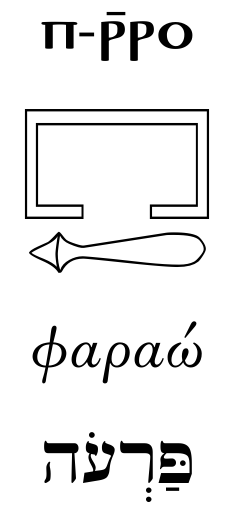
We customarily tend to refer to the early rulers of Egypt as “Pharaoh”, even though this is actually a Greek word (φαραώ), based on an Egyptian phrase: https://www.ancient.eu/pharaoh/
The word 'pharaoh’ is the Greek form of the Egyptian pero or per-a-a, which was the designation for the royal residence and means `Great House'. The name of the residence became associated with the ruler and, in time, was used exclusively for the leader of the people.
And the term was applied to the rulers of the great nation only at a late stage in Egypt’s dynastic history.
Tradition accredits “Menes” with being the unifying founder of Egyptian dynastic history, the first ruler of the First Dynasty.
And some suggest that Menes was the same as Hor-Aha, whose nebty name was Min, or Men. For instance: http://www.ancient-egypt.info/2012/02/hor-aha-and-founding-of-memphis.html
Hor-Aha … took the nebti name (the second royal name: p. 218) of Men, which means 'established', and this could be the origin of the later record of the first king as being called Menes. For present purposes we may look on Hor-Aha as the first king of the 1st Dynasty. An interesting piece of evidence is a small broken ivory label found in the tomb of Queen Nithotep at Naqada. Although schematically represented, the busy scene on this tiny piece seems to show two humans celebrating a ceremony called 'Receiving the South and the North' over an unidentified object (possibly the first representation of the later symbolic tying of papyrus and lotus stalks).

….

The king's name, meaning 'Fighting Hawk' - an allusion again to Horus - indicates his Upper Egyptian origin and rule. His adoption of Men as his nebti name for ruling over both parts is indicated on the ivory label by the fact that his Horus name (his first and principal name, p. 218) Hor-Aha, and his nebti name, Men, appear side by side. Other similar small labels from Early Dynastic tombs indicate that his was not an easy reign. There were campaigns to be fought and rebels to be subdued in Nubia, recorded on a wooden label from Abydos, and another label records his foundation of a temple to the goddess Neith at Sais in the Delta. Her warlike aspect was signified by a pair of crossed arrows and her worship continued into Roman times when she was identified with Athena at Sais. ….
For more on Neith (Athena), see my series:
Neith a goddess of greatest antiquity
That Menes and Hor-Aha were one and the same potentate is a view that I, too, favour, along with a tradition that Menes was the (somewhat ill-fated) pharaoh of Abram (= Abraham).
To that mix I have added that Menes/Hor-Aha was the biblical “Abimelech”.
An earlier article of mine on these biblico-historical correspondences has been picked up at: https://thepharaohofabraham.wordpress.com/2011/11/13/the-genealogy-of-israel-according-to-scripture/
…. Finally, whether the one whom Isaac calls “Abimelech” was still, in Isaac’s day, “Pharaoh” of Egypt, as he had been in former times, he was most definitely at least ruler over the Philistines at Gerar. Perhaps he ruled both lands, Egypt and Philistia. Be that as it may, the Holy Spirit has apparently provided the name of Abram’s “Pharaoh”. But one needs to respect His literary structures to discover that name. We now know his personal name: “Abimelech”.
In Hebrew it means “Father is King”.
Since Abimelech is not an Egyptian name, though (see discussion of this in 2. below), and since the other designation that we have for him is simply “Pharaoh”, that data, in itself, will not take us the next step of being able to identify this ruler in the Egyptian historical (or dynastic) records. But that our Abimelech may have – according to the progression of Ishmael’s and Isaac’s toledôt histories – ruled Egypt and then gone on
to rule Philistia, could well enable us to locate this ruler archaeologically.
Dr. John Osgood has already done much of the ‘spade work’ for us here, firstly by nailing the archaeology of En-geddi at the time of Abram (in the context of Genesis 14) to the Late Chalcolithic period, corresponding to Ghassul IV in Palestine’s southern Jordan Valley; Stratum V at Arad; and the Gerzean period in Egypt (“The Times of Abraham”, Ex Nihilo TJ, Vol. 2, 1986, pp. 77-87); and secondly by showing that, immediately following this period, there was a migration out of Egypt into Philistia, bringing an entirely new culture (= Early Bronze I, Stratum IV at Arad).
P. 86: “In all likelihood Egypt used northern Sinai as a springboard for forcing her way into Canaan with the result that all of southern Canaan became an Egyptian domain”.
This new phase would seem to correspond very nicely with the time of Narmer,
since, at this very archaeological phase, according to Osgood (ibid., p. 85):
Belonging to Stratum IV [at Arad] Amiram found a sherd with the name of Narmer …”. ….
[End of quote]
How might this Narmer fit into this new scheme of things?
Without my claiming to be certain about it, I personally like the thought that Narmer may have been the Akkadian ruler, Naram-Sin:
Narmer a Contemporary of Patriarch Abraham. Part Two: Narmer as Naram Sin
What would strengthen this correspondence, at least chronologically, is W. F. Albright’s remarkable thesis that Naram-Sin had actually conquered Menes of Egypt:
Dr. W.F. Albright’s Game-Changing Chronological Shift
All of this, if correct, would mean that, around c. 1900 BC (a conventional dating for Abram) we have a veritable clash of titans: Naram-Sin of Akkad, Menes of Egypt, and Patriarch Abram. Not to mention Melchizedek of Salem and Chedorlaomer of Elam, and so on.
A glimpse of this remarkable age has even been projected into a false C6th AD time warp:
Chedorlaomer and Chlodomer


I suspect that there may be much, much more to Naram-Sin the Akkadian than meets the eye.
For one, Naram-Sin strikes me now as being the stand-out candidate for the enigmatic biblical “Amraphel … king of Shinar”, contemporary of Abram. (Genesis 14:1). See e.g. my article:
Narmer a Contemporary of Patriarch Abraham. Part Three: (Narmer) Naram Sin as Amraphel

Part Two:

Best biblico-historical (Egyptian) syncretisms

“According to historians, King Aha ruled Egypt early after the unification of Egypt (Tyldesley, 2009, p. 22), and would have held sway over essentially all the available land. This shows that the civilization of Egypt had already developed to the point of having a powerful pharaoh who obviously had a reputation for ruthlessness as indicated by Abraham’s fear of him”.

Anne Habermehl 


A-ha, someone else has suggested that Aha may have been ruler of Egypt at the time of Abram!


And what I like about this scenario is that the same writer, Anne Habermehl, also has the visionary Joseph in place as Imhotep of the Third Egyptian Dynasty. See e.g. my article:


Era of Biblical Joseph Necessitates Re-alignment of Old Egyptian Dynasties. Part One: Joseph and Egypt’s Third Dynasty


I personally think that Abram – 1st Dynasty; Joseph – 3rd Dynasty is the correct alignment.


Anne Habermehl has written thus on the coinciding of Abram and Aha of Egypt in her article,


ANCIENT EGYPT, THE ICE AGE, AND BIBLICAL CHRONOLOGY


….

WHEN DID ABRAHAM VISIT EGYPT?


One potential synchronism between the Bible and secular history is Abraham’s temporary migration into Egypt, forced by a severe famine in Canaan (Gen. 12:10–20). The Bible does not tell us the name of Abraham’s pharaoh, and that omission introduces uncertainty as to when in Egypt’s history Abraham was there. An earliest date of about 1920 BC for Abraham’s Egyptian visit is based on 1921 BC for his entry into Canaan (Jones, 2007, p. 25). Scripture does not tell us how long Abraham was in Canaan before going to Egypt. (The LXX reduces these dates by 40 yrs. In I Kings 6:1, the time from the Exodus to beginning the building of the temple is 440 yrs. instead of 480 yrs. as in the MT.)


Abraham’s visit to Egypt would have occurred about 200 years before Joseph became vizier of Egypt. The placement of Joseph in the 3rd Dynasty of Egypt as the famous vizier Imhotep is argued by Habermehl (2013). Imhotep’s era is generally placed around 2700–2600 BC on the secular timeline (Tyldesley, 2009, p. 32). Because we know the secular timeline to be more extended than the biblical one, it would therefore be plausible that Abraham’s visit might have been about 300 yrs. (secular timeline) before Joseph. If so, this would put Abraham’s visit to Egypt somewhere around 3000 BC on the secular timeline, near the beginning of the 1st Dynasty.


There is some known ancient history that may support this date. The first king of the 1st Dynasty is generally believed to be King Aha, whose reign began c. 3000 BC on the secular timeline (Tyldesley 2009, p. 22; Shaw 2003, p. 481). During this king’s reign, the colonies of Egyptians who had been living in south Palestine abandoned their residences and returned to Egypt for unknown reasons, but then returned to Canaan later on during the 1st Dynasty (Raffaele, 2003; Porat, 1992; Watrin, 1998, pp. 1224–26). This author suggests that the same severe famine in Canaan that drove Abraham to Egypt may have caused these Egyptians to return home at this time.


We also note that Abraham did not appear to have the option of circumventing this powerful pharaoh. For his own personal safety (because of Sarah’s beauty), Abraham might have liked to pasture his animals in a section of Egypt that was not under this pharaoh’s rule. But the fact that he did not do so would indicate that he was obligated to deal with this particular pharaoh. According to historians, King Aha ruled Egypt early after the unification of Egypt (Tyldesley, 2009, p. 22), and would have held sway over essentially all the available land.

This shows that the civilization of Egypt had already developed to the point of having a powerful pharaoh who obviously had a reputation for ruthlessness as indicated by Abraham’s fear of him.


Placing Abraham in Egypt near the beginning of the 1st Dynasty would be earlier in Egypt’s history than many scholars have led us to believe. The well-respected Cook (1871, p. 447) thought Abraham was in Egypt between the 11th and 13th Dynasty. Ashton & Down (2006, p. 37) put Abraham in Egypt in the time of Kufu (4th Dynasty).However, those who place Abraham later on in Egyptian history have a problem, in that they have to fit even more historical events into the period between the Ice Age and Abraham’s visit. ….

[End of quote]


The article then goes horribly wrong, I believe, in locating the prophet Job to only “several generations after Abraham”:


We can conclude that by Abraham’s time the Ice Age was long past because it had ended earlier at the time of the Nile’s wild flow, and all development of Egypt’s civilization had taken place after that. This also means that Job did not live during the Ice Age, as is believed by various writers (e.g., Northrup, 1996). Job lived several generations after Abraham (Job 42:17 LXX). ….

[End of quote]


The prophet Job live into the era of the “Chaldeans” (Job 1:17), conventionally more than a millennium after Abraham. See e.g. my article:


Job's Life and Times


Job was Tobias, son of Tobit, of the C8th BC (conventional dating).

Ashurnasirpal I-II ‘King of the World’


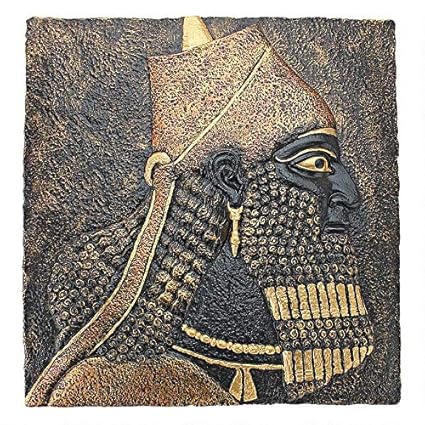
 Design Toscano King Ashurnasirpal II Nimrud Relief Wall Frieze Sculpture, 13 Inch, Black and Gold

by
 
Damien F. Mackey


“In the understanding of the people of the Near East at that time,
[Ashurnasirpal II] really was “king of the world”.”
 
Joshua J. Mark


Dreams, visions, superstition, megalomania, cruelty, fiery furnace, messing with the rites, building of Babylon, mysterious and enduring illness, madness, conquest of Egypt -
these were some of the ‘symptoms’ exhibited by the bunch of Assyro-Babylonian (Persian) ‘kings’ whom I lumped together as being various faces of the one historical Nebuchednezzar.
 
Names such as:
 
Esarhaddon who, deliberately reading the specified ritual number upside down, rebuilt Babylon, who also suffered a long, dreadful and alienating illness, and who attacked Egypt.
 
Ashurbanipal whose 43-year reign was the same length as Nebuchednezzar’s, who burned his brother in a fiery furnace, and who absolutely smashed Egypt.
 
Nabonidus who is regarded by some biblical commentators and historians as being the true model for the ‘Nebuchadnezzar’ of the Book of Daniel. Highly pious, superstitious, suffering from madness and foreboding dreams.
 
Cambyses who was also quite mad, and whose other name was “Nebuchednezzar”, and who, too, conquered Egypt.
 
And there were other potential ones as well, such as Velikovsky’s choice for Nebuchednezzar, Hattusilis of Hatti, another chronic illness sufferer.
 
All of this is set out in my multi-part series:
 
"Nebuchednezzar Syndrome": dreams, illness-madness, Egyptophobia
 
beginning with:
 
https://www.academia.edu/37511819/_Nebuchednezzar_Syndrome_dreams_illness-madness_Egyptophobia._Part_One_Brief_Introductory_Section
 
Now I have a new candidate for consideration, Ashurnasirpal (especially II). 
This king has been, to date, a real headache for revisionists to place in any satisfactory way. And that same statement applies even more to his supposed son, Shalmaneser III, who initially ended up straddling the mid-C9th BC right where Dr. I. Velikovsky had located the El Amarna [EA] period, prompting Velikovsky to attempt identifying Shalmaneser III with the Kassite ruler of Babylonia at the time of EA, Burnaburiash II (c. 1359 – 1333 BC, conventional dates).
 
 
A suggested folding of
‘Middle’ and ‘Neo’ Assyria
 
 
“As we know from the correspondence left by the roya1 physicians and exorcists … [Esarhaddon’s] days were governed by spells of fever and dizziness, violent fits of vomiting, diarrhoea and painful earaches. Depressions and fear of impending death”.


Following on from my tentative identification of Tukulti-Ninurta I as the neo-Assyrian king, Sennacherib (a connection originally suggested by Phillip Clapham):
 
Can Tukulti-Ninurta I be king Sennacherib?
 
https://www.academia.edu/40246318/Can_Tukulti-Ninurta_I_be_king_Sennacherib
 
I must now consider the possibility that “Ashurnasirpal”, said to have been the son-successor of a Tukulti-Ninurta (II), was the actual successor of Sennacherib, that is, Esarhaddon, who is, in turn, in my scheme of things, Nebuchednezzar himself:
 
Esarhaddon a tolerable fit for King Nebuchednezzar
 
https://www.academia.edu/38017900/Esarhaddon_a_tolerable_fit_for_King_Nebuchednezzar
 
"As we know from the correspondence left by the roya1 physicians and exorcists … his days were governed by spells of fever and dizziness, violent fits of vomiting, diarrhoea and painful earaches. Depressions and fear of impending death... more
 
Esarhaddon a tolerable fit for King Nebuchednezzar. Part Two: Another writer has picked up this possible connection
 
https://www.academia.edu/37525605/Esarhaddon_a_tolerable_fit_for_King_Nebuchednezzar._Part_Two_Another_writer_has_picked_up_this_possible_connection
 
Esarhaddon a tolerable fit for King Nebuchednezzar. Part Three: ‘The Marduk Prophecy’
 
https://www.academia.edu/39725289/Esarhaddon_a_tolerable_fit_for_King_Nebuchednezzar._Part_Three_The_Marduk_Prophecy_
 
Nor is there any surprise in learning that ‘The Marduk Prophecy’ bears striking parallels with Esarhaddon’s inscriptions for the same reason (Esarhaddon is Ashurbanipal). And, according to this present series, Esarhaddon (Ashurbanipal) is... more
 
See also my:
 
Aligning Neo-Babylonia with Book of Daniel. Part Two: Merging late neo-Assyrians with Chaldeans
 
https://www.academia.edu/38330399/Aligning_Neo-Babylonia_with_Book_of_Daniel._Part_Two_Merging_late_neo-Assyrians_with_Chaldeans
 
Admittedly this is something of a long stretch in the present scheme of things.
While, fittingly, the father of Tukulti-Ninurta I is said to have been a Shalmaneser – just as in my revision the father of (Sargon II =) Sennacherib was a Shalmaneser, his son is said to have been one Ashur-nadin-apli.
Tukulti-Ninurta II, on the other hand, who was the father of Ashurnasirpal II, is said to have had a father named Adad-nirari (II). Tukulti-Ninurta II, though, does not even rate a mention in the index at the back of Marc Van de Mieroop’s text, A History of the Ancient Near East ca. 3000-323 BC. Putting it all together, I would tentatively suggest this sequence:
 
Shalmaneser (I, III);
Tukulti-Ninurta (I, II);
Ashur-nadin-apli-Ashurnasirpal (I, II)
 
equates to, respectively:
Shalmaneser (V);
Sargon II-Sennacherib;
Esarhaddon-Ashurbanipal-Nebuchednezzar
 
Joshua J. Mark tells us much about this great and cruel king in his article, “Ashurnasirpal II”: https://www.ancient.eu/Ashurnasirpal_II/ some of which I give here with my comments added:
 
Ashurnasirpal II (reigned 884-859 BCE) was the third king of the Neo-Assyrian Empire. His father was Tukulti-Ninurta II (reigned (891-884 BCE) whose military campaigns throughout the region provided his son with a sizeable empire and the resources to equip a formidable army.
 
My comment: If the revision that I am putting together in this series - albeit tentatively - is heading in the right direction, then these dates for Ashurnasirpal and his father are far too high.
The “father”, Tukulti-Ninurta so-called II, who does not even rate an entry in the index at the back of Van de Mieroop’s book (as we have already found), stands sorely in need of a significant alter ego, that being, as I have suggested, none other than Sargon II-Sennacherib.
 
Ashurnasirpal II is known for his ruthless military conquests and the consolidation of the Assyrian Empire, but he is probably most famous for his grand palace at Kalhu (also known as Caleh and Nimrud in modern-day Iraq), whose wall reliefs depicting his military successes (and many victims) are on display in museums around the world in the modern day. In addition to the palace itself, he is also known for throwing one of the most impressive parties in history to inaugurate his new city of Kalhu: he hosted over 69,000 people during a ten day festival. The menu for this party still survives in the present day.
 
My comment: One of my alter egos for Ashurnasirpal is Esarhaddon, who was indeed interested in Kalhu: http://oracc.museum.upenn.edu/nimrud/ancientkalhu/thecity/latekalhu/index.html
 
.... Esarhaddon, however, took a great deal of interest in the city. Around 672 BC, towards the end of his reign, he rebuilt part of the city wall and made significant improvements to Fort Shalmaneser. He added a new terrace and created an impressive new entrance consisting of a vaulted ramp which led from a newly-rebuilt postern gate TT  directly into the palace through a series of painted rooms. Inscriptions on both sides of the gate commemorated this construction work, as did clay cylinders which were perhaps originally deposited inside Fort Shalmaneser's walls ....
 
It is possible that Esarhaddon's activities at Kalhu were intended as a prelude to reclaiming it as royal capital. There is some, albeit very limited evidence, that he may have lived at Kalhu briefly towards the end of his reign: a partially preserved letter mentions that the king's courtiers "are all in Kalhu", perhaps indicating that the court had moved there from Nineveh (SAA 13: 152). ....
 
My comment: As for Ashurnasirpal’s being “ruthless”, his cruelty is legendary (see below). And in this he resembles his other alter ego, Ashurbanipal (‘Ashur is the creator of an heir’), whose name is almost identical to Ashurnasirpal (‘Ashur is guardian of the heir’).
The following piece tells of Ashurnasirpal’s, of Ashurbanipal’s overt cruelty:
https://searchinginhistory.blogspot.com/2015/02/cruelty-instrument-of-assyrian-control.html
 
Many Kings of Assyrian had displayed proudly their cruelty towards their enemies. Sometimes in reliefs or in their annals, New Assyrian [kings] gave detail[s] of their gory exploits against their opponents.
King Ashurnasirpal laid out many of his sadistic activities in one of his annals. He liked burning, skinning, and decapitating his enemies. When he defeated a rebelling city, he made sure they [paid] a huge price. Disobedient cities were destroyed and razed to the ground with fire, with their wealth and all material riches taken by the king. Their youth and women were either burned alive or made into slaves or placed into the harem. In the City of Nistun, Ashurnasirpal showed how he cut [off] the heads of 260 rebelling soldiers and piled it together.
Their leader named Bubu suffered horrific punishment. He was flayed and his skin was placed in the walls of Arbail.
In the city of Suri, rebelling nobles were also skinned and were displayed like trophies. Some skin were left to rot but some were placed in a stake. Officials of the city suffered decapitation of their limbs. The leader of the Suri rebellion, Ahiyababa, underwent flaying and his skin was then placed in the walls of Niniveh. After Ashurnasirpal defeated the city of Tila, he ordered to cut the hands and feet of the soldiers of the fallen city. Other than that, some soldiers found themselves without noses and ears. But also, many defeated soldiers had their eyes gouged out. The heads of the leaders of the Tila were hang[ed] in the trees around the city.
 
Ashurnasirpal was not alone in having a psychotic mind. Many of his successors followed his brutality towards enemies.
....
The intellectual King Ashurbanipal also had a share of cruelty. Although he was known for his great library in Nineveh, he was not as merciful as he seemed. One time, an Arabian leader name Uaite instigated a rebellion. Ashurbanipal managed to defeat Uaite and captured him and brought back to Niniveh. There, he brought upon a humiliating punishment. He was tied like a dog and placed in a kennel alongside with dogs and jackals guarding the gates of the great Assyrian capital of Nineveh. ....
 
The Book of Daniel’s “Nebuchadnezzar” was likewise an insane and cruel king, he being perhaps “the basest of men” (4:17): https://biblehub.com/commentaries/daniel/4-17.htm
 
And setteth over it the basest of men — If this be applied to Nebuchadnezzar, it must be understood, either with respect to his present condition, whose pride and cruelty rendered him as despicable in the sight of God as his high estate made him appear honourable in the eyes of men; and, therefore, was justly doomed to so low a degree of abasement: or else it may be interpreted of his wonderful restoration and advancement after he had been degraded from his dignity. ....
 
He reigned for 25 years and was succeeded by his son, Shalmaneser III, who reigned from 859-824 BCE.
 
My comment: If the revision that I am putting together in this series - albeit tentatively - is heading in the right direction, then Ashurnasirpal’s reign was far longer than “25 years”, was 43 years. And Shalmaneser was not his “son”, but his grandfather.
 
Early Reign and Military Campaigns
 
... by the time Ashurnasirpal II came to the throne, he had at his disposal a well-equipped fighting force and considerable resources.
He put both of these to use almost at once. He was not so much interested in expansion of the empire as in securing it against invasion from without or rebellion from within.
 
My comment: Ashurnasirpal was very much “interested in expansion of the empire”.
When fitted with his alter egos, he becomes the conqueror of even the distant land of Egypt.
 
He also was required, as an Assyrian king, to combat the forces of chaos and maintain order. The historian Marc Van De Mieroop writes, “The king, as representative of the god Assur, represented order.
Wherever he was in control, there was peace, tranquility, and justice, and where he did not rule there was chaos. The king’s duty to bring order to the entire world was the justification for military expansion” (260). While Ashurnasirpal may not have considered expansion a priority, he certainly took order in his realm very seriously and would not tolerate insubordination or revolt.
His first campaign was in 883 BCE to the city of Suru to put down a rebellion there. He then marched to the north where he put down other rebellions which had broken out when he took the throne. He was not interested in having to expend more time and resources on future rebellions and so made an example of the rebels in the city of Tela. In his inscriptions he writes:
 
I built a pillar over against the city gate and I flayed all the chiefs who had revolted and I covered the pillar with their skins. Some I impaled upon the pillar on stakes and others I bound to stakes round the pillar. I cut the limbs off the officers who had rebelled. Many captives I burned with fire and many I took as living captives. From some I cut off their noses, their ears, and their fingers, of many I put out their eyes. I made one pillar of the living and another of heads and I bound their heads to tree trunks round about the city. Their young men and maidens I consumed with fire. The rest of their warriors I consumed with thirst in the desert of the Euphrates.
 
My comment: Interestingly, Joshua J. Mark (“Assyrian Warfare”) applies this horrific Suru episode instead to Ashurbanipal:
 
The Assyrian kings were not to be trifled with and their inscriptions vividly depict the fate which was certain for those who defied them. The historian Simon Anglim writes:
 
The Assyrians created the world's first great army and the world's first great empire. This was held together by two factors: their superior abilities in siege warfare and their reliance on sheer, unadulterated terror. It was Assyrian policy always to demand that examples be made of those who resisted them; this included deportations of entire peoples and horrific physical punishments. One inscription from a temple in the city of Nimrod records the fate of the leaders of the city of Suru on the Euphrates River, who rebelled from, and were reconquered by, King Ashurbanipal:
 
“I built a pillar at the city gate and I flayed all the chief men who had revolted and I covered the pillar with their skins; some I walled up inside the pillar, some I impaled upon the pillar on stakes."
 
My comment: In the Babylonian Chronicles Nebuchednezzar mentions his conquest of Suru: The king of Suru; the king of Hazzati ...”.
 
This treatment of defeated cities would become Ashurnasirpal II’s trademark and would include skinning insubordinate officials alive and nailing their flesh to the gates of the city and “dishonoring the maidens and boys” of the conquered cities before setting them on fire.
With Tela destroyed, he moved swiftly on to other campaigns. He marched west, fighting his way through other rebel outbreaks and subjugating the cities which opposed him. The historian John Boardman notes that “a major factor behind the increasing resistance was probably the heavy tribute exacted by Ashurnasirpal…one has the impression that a particularly large amount of booty was claimed by this king and that corvee [forced labor] was imposed universally” (259). Ashurnasirpal II led his army on successful campaigns across the Euphrates River and all the way to the Mediterranean Sea, where he washed his weapons as a symbol of his conquests (an act made famous by the inscriptions of Sargon the Great of the earlier Akkadian Empire after he had established his rule).
 
My comment: Ashurbanipal, likewise, ‘washed his weapons in the Sea’ (Warfare, Ritual, and Symbol in Biblical and Modern Contexts, p. 223): “Inscriptions from ... Ashurnasirpal II ... and Ashurbanipal ... record washing their weapons in the Mediterranean Sea and offering sacrifices ...”.
 
Although some sources claim he then conquered Phoenicia, it seems clear he entered into diplomatic relations with the region, as he did also with the kingdom of Israel. The surviving populaces of the cities and territories he conquered were, as per Assyrian policy, relocated to other regions in the empire in order to distribute skills and talent.
 
My comment: If Ashurnasirpal were also Esarhaddon-Ashurbanipal-Nebuchednezzar, as I am proposing, then he most certainly conquered Phoenicia, Israel, and more. For example:
 
Esarhaddon:
https://www.livius.org/sources/content/anet/291-esarhaddons-prism-b/
.... the Assyrian king Esarhaddon (r.680-669) tightened the Assyrian grip on the cities of Phoenicia. Sidon was sacked in 677/676 and its people were deported. In the next year, 676/675, the cities of Syria and Cyprus were ordered to contribute building materials for a monument in Nineveh.
The inscription mentions two groups of contributing kings: those ruling over the Levantine cities and those ruling the colonies in the west. It also mentions their tributes. The text has attracted considerable attention because it also mentions King Manasseh of Judah, who ruled from 687 to 642. ....
 

Esarhaddon's Prism B


[1] I called up the kings of the country Hatti and (of the region) on the other side of the river Euphrates: Ba'al, king of Tyre; Manasseh, king of Judah; Qawsgabar, king of Edom; Musuri, king of Moab; Sil-Bel, king of Gaza; Metinti, king of Ashkelon; Ikausu, king of Ekron; Milkiashapa, king of Byblos; Matanba’al, king of Arvad; Abiba'al, king of Samisimuruna; Puduil, king of Beth-Ammon; Ahimilki, king of Ashdod ....
 
Ashurbanipal:
https://www.spectator.co.uk/2018/12/the-assyrians-of-ashurbanipals-time-were-just-as-into-pillage-and-destruction-as-isis/
Ashurbanipal overcame chaos by conquering Egypt, campaigning against Phoenician Tyre, and warring against the Elamites of south-western Iran. One of the most arresting sculptures in the exhibition shows him dining with his wife in the luxurious gardens of his palace in the aftermath of his victory over Elam. He reclines beneath a particularly luscious grapevine (his gardens were irrigated by a network of artificial channels); the head of the Elamite king is staked on the branch of a tree. ....
 
Nebuchednezzar:
https://www.thebiblejourney.org/biblejourney2/33-judah-after-the-fall-of-israel/king-nebuchadnezzar-of-babylon-invades-judah-/
... in 589BC, Zedekiah rebelled against Nebuchadnezzar and Jerusalem was beseiged again for over a year and a half before finally falling in 587BC. The Temple was destroyed and the population was taken into exile in Babylonia (see 2 Kings 25:1-10).
Nebuchadnezzar then proceeded to conquer Phoenicia in 585BC and to invade Egypt in 567BC. The dominance of Babylonia only came to an end when King Cyrus of Persia captured Babylon in 539 BC, and Babylonia became part of the Persian Empire (see Ezra 1:1).
 
Having accomplished what he set out to do on campaign, he turned around and headed back to his capital city of Ashur. If there were any further revolts to be put down on his march back, they are not recorded. It is unlikely that there were more revolts, however, as Ashurnasirpal II had established a reputation for cruelty and ruthlessness which would have been daunting to even the most ardent rebel. The historian Stephen Bertman comments on this, writing:
 
Ashurnasirpal II set a standard for the future warrior-kings of Assyria. In the words of Georges Roux, he `possessed to the extreme all the qualities and defects of his successors, the ruthless, indefatigable empire-builders: ambition, energy, courage, vanity, cruelty, magnificence’ (Roux 1992:288). His annals were the most extensive of any Assyrian ruler up to his time, detailing the multiple military campaigns he led to secure or enlarge his nation’s territorial dominion. From one raid alone he filled his kingdom’s coffers with 660 pounds of gold an equal measure of silver, and added 460 horses to his stables. The sadistic cruelty he inflicted upon rebel leaders was legendary, skinning them alive and displaying their skin, and cutting off the noses and the ears of their followers or mounting their severed heads on pillars to serve as a warning to others (79-80).
 
.... His famous Standard Inscription told again and again of his triumphs in conquest and vividly depicted the horrible fate of those who rose against him. The inscription also let the dignitaries from his own realm, and others, know precisely who they were dealing with. He claimed the titles “great king, king of the world, the valiant hero who goes forth with the help of Assur; he who has no rival in all four quarters of the world, the exalted shepherd, the powerful torrent that none can withstand, he who has overcome all mankind, whose hand has conquered all lands and taken all the mountain ranges” (Bauer, 337). His empire stretched across the territory which today comprises western Iran, Iraq, Syria, Jordan, and part of Turkey. Through his diplomatic relationships with Babylonia and the Levant, he also had access to the resources of southern Mesopotamia and the sea ports of Phoenicia. In the understanding of the people of the Near East at that time, he really was “king of the world”.
 
“Nebuchadnezzar Syndrome”:
 
Dreams, visions: “Assurnasirpal built a palace and a temple for the dream god Mamu ...”:
http://oracc.museum.upenn.edu/nimrud/ancientkalhu/thepeople/assurnasirpalii/index.html
 
Superstition: "Fear and Superstition in the Northwest Palace of Aššurnaṣirpal II".
https://www.academia.edu/34275633/_Fear_and_Superstition_in_the_Northwest_Palace_of_
 
Megalomania, cruelty: “Ashurnasirpal II is the epitome of everything you would ever want out of a psychotically deranged vengeance-sucking ancient conquest-mongering megalomaniac who drove his jet-fuel-powered chariot across a road paved with corpses so he could kill a lion with his fists”. http://www.badassoftheweek.com/index.cgi?id=461274131521
 
Fiery furnace, lions’ den: “Many captives I burned with fire”
“The Assyrian king Ashurnasirpal II (883-859 BC) is reported to have maintained a breeding farm for lions at Nimrud”. http://www.jesuswalk.com/daniel/3_faithfulness.htm
 
Messing with the rites (unorthodox): “Ashurnasirpal II holding a bowl, detail of a relief. Note the King’s facial expression, headgear, hair, earring, necklace, mustache, beard, wrist bracelet, armlets, daggers, and the bowl he holds with his right hand. The left hand holds a long royal staff. The King’s attire is superb. What is unusual in this scene is that the King’s royal attendant is “taller” than the King himself!”
http://etc.ancient.eu/exhibitions/wall-reliefs-ashurnasirpal-ii-north-west-palace/
 
Mysterious and enduring illness: His prayer to the goddess Ishtar ... “lamentation over the kings underserved suffering for a persistent illness” (Donald F. Murray, Divine Perogative and Royal Pretension: Pragmatics, Poetics and Polemics ..., pp. 266-267):
 
http://jewishchristianlit.com/Texts/ANEhymns/lamIshtr.html
 
....
I have cried to thee, suffering, wearied, and distressed, as thy servant.
See me O my Lady, accept my prayers.
Faithfully look upon me and hear my supplication.
Promise my forgiveness and let thy spirit be appeased.
Pity! For my wretched body which is full of confusion and trouble.
Pity! For my sickened heart which is full of tears and suffering.
Pity! For my wretched intestines (which are full of) confusion and trouble.
Pity! For my afflicted house which mourns bitterly.
Pity! For my feelings which are satiated with tears and suffering.
O exalted Irnini, fierce lion, let thy heart be at rest.
O angry wild ox, let thy spirit be appeased.
Let the favor of thine eyes be upon me.
With thy bright features look faithfully upon me.
Drive away the evil spells of my body (and) let me see thy bright light.
How long, O my Lady, shall my adversaries be looking upon me,
In lying and untruth shall they plan evil against me,
Shall my pursuers and those who exult over me rage against me?
How long, O my Lady, shall the crippled and weak seek me out?
One has made for me long sackcloth; thus I have appeared before thee.
The weak have become strong; but I am weak.
I toss about like flood-water, which an evil wind makes violent.
My heart is flying; it keeps fluttering like a bird of heaven.
I mourn like a dove night and day.
I am beaten down, and so I weep bitterly.
With "Oh" and "Alas" my spirit is distressed.
I - what have I done, O my god and my goddess?
Like one who does not fear my god and my goddess I am treated;
While sickness, headache, loss, and destruction are provided for me;
So are fixed upon me terror, disdain, and fullness of wrath,
Anger, choler, and indignation of gods and men.
I have to expect, O my Lady, dark days, gloomy months, and years of trouble.
I have to expect, O my Lady, judgment of confusion and violence.
Death and trouble are bringing me to an end.
Silent is my chapel; silent is my holy place;
Over my house, my gate, and my fields silence is poured out.
As for my god, his face is turned to the sanctuary of another.
My family is scattered; my roof is broken up.
(But) I have paid heed to thee, my Lady; my attention has been turned to thee.
To thee have I prayed; forgive my debt.
Forgive my sin, my iniquity, my shameful deeds, and my offence.
Overlook my shameful deeds; accept my prayer;
Loosen my fetters; secure my deliverance;
Guide my steps aright; radiantly like a hero let me enter the streets with the living.
....